
Reviewed by Michael Dunstan, Managing Director of Palmers Relocations | Originally published 27 November 2021 | Updated 10 November 2026
Shipping a Car Overseas from Australia: What to Know Before You Book
At a glance
- Establish whether your particular vehicle can be imported and registered at the destination before booking shipping.
- Compare the full cost of taking it with selling in Australia and replacing it after arrival.
- Customs clearance, tax relief and permission to use the vehicle on the road are separate matters.
- Keep evidence of ownership, use, registration and purchase, alongside your relocation documents.
- Shipping options, preparation requirements and timeframes depend on the vehicle, route and service.
- Tell your moving specialist about modifications, damage, finance and whether the car is travelling alongside household belongings.
There is something reassuring about keeping a car you know. You understand its history, it suits your household, and replacing it is another decision you may prefer to avoid while organising an overseas move.
Sometimes, taking it with you is a sensible choice.
The important part is working through the destination requirements before the car leaves Australia. A vehicle can arrive safely at a port and still need further approvals, inspections or modifications before it can be registered.
Start with the car itself and where it is going. Once those details are understood, the shipping conversation becomes much more useful.
Is it worth taking your car overseas?
Begin with two realistic figures: what you could sell the car for in Australia, and what it would cost to buy a suitable replacement at your destination.
Then build the full cost of taking it.
| Cost to consider | What to establish |
|---|---|
| Transport in Australia | Collection, depot delivery and any additional handling |
| International shipping | The proposed service, route and freight inclusions |
| Destination handling | Port or depot charges, customs work and onward transport |
| Duties and taxes | What applies and whether you qualify for relief |
| Inspections and preparation | Biosecurity, cleaning, certification or testing where required |
| Getting it on the road | Modifications, registration, plates, licensing and local insurance |
| Time without the car | Temporary transport while shipping and arrival procedures are completed |
Some of these costs may be included in a quotation. Others may be payable separately. Compare the written scope rather than assuming a shipping price covers everything through to driving away.
Condition matters too. A reliable vehicle you intend to keep for years presents a different decision from one already needing substantial repairs.
There is also room for personal attachment. A vehicle you have owned for a long time may be worth keeping even when the financial comparison is close. Understanding the full process lets you make that choice with fewer unknowns.
Establish whether your vehicle is eligible first
Give your moving specialist the make, model, year, vehicle identification number and destination.
Mention anything that could affect its assessment: modifications, previous accident damage, a salvage history, an unusual specification or substantial accessories. Include dimensions where the vehicle has roof racks, a canopy or other additions.
The fact that it is registered in Australia does not automatically establish that another country will accept it for road use.
For New Zealand, NZ Transport Agency Waka Kotahi recommends contacting an entry certifier while considering the import of a particular vehicle. That is a useful point in the process to resolve eligibility questions, while you can still change the plan.
For other destinations, use the relevant transport authority’s requirements. Age alone rarely tells you everything you need to know.
If the car is financed or leased
Speak with the lender or leasing company before making shipping commitments. Establish whether export is permitted under your agreement and what consent or settlement arrangements are required.
Tell your moving specialist about the situation early. Finance documents and import eligibility answer different questions; both may need attention.
Understand the shipping option being offered
Vehicle shipping can involve container transport or, on suitable routes, roll-on/roll-off services, commonly called RoRo.
With container shipping, the vehicle is loaded and secured inside a shipping container. A proposed service may use a dedicated container or a shared arrangement, depending on availability and the move.
RoRo uses a vehicle carrier with a different loading and handling process. The services should be compared by their actual inclusions, restrictions and destination arrangements.
For New Zealand vehicle moves, Palmers uses containerised Shared / Groupage and Dedicated / Sole-use services, rather than RoRo. Our guide to moving a car from Australia to New Zealand explains those options in detail.
For another destination, discuss the service available for your particular vehicle and route.
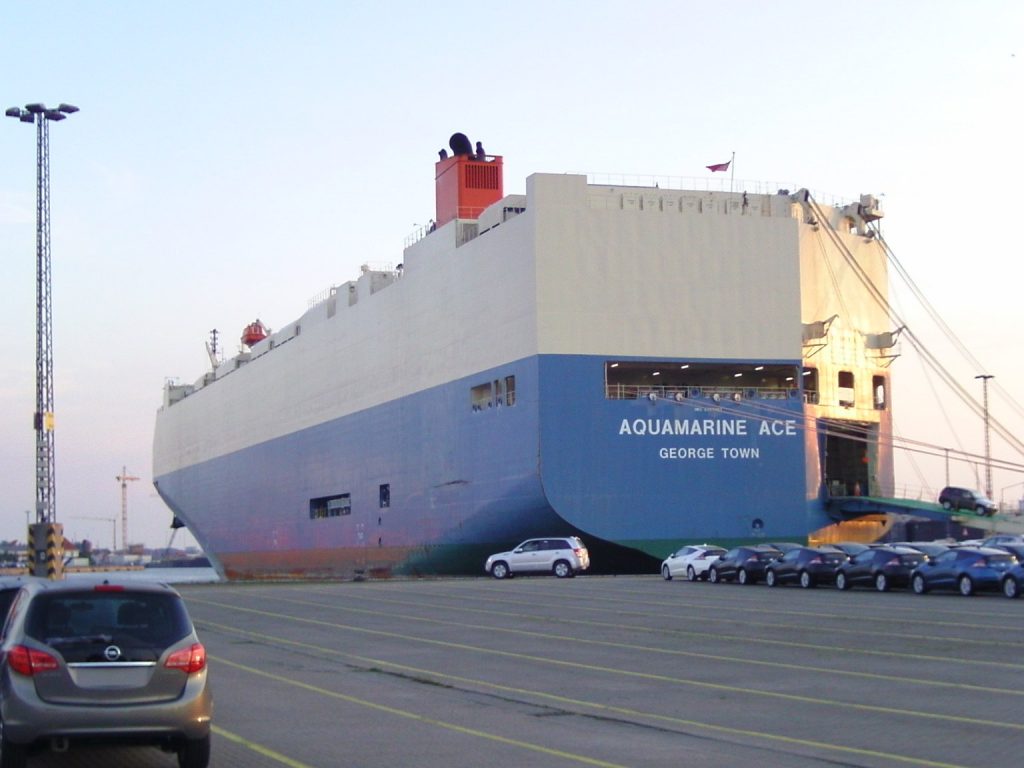
“A roll-on/roll-off vehicle carrier at port. Shipping arrangements vary by route and provider; Palmers’ NZ vehicle services are containerised.”
Can the car travel with your furniture?
It may be possible to arrange the vehicle alongside your household shipment, but it needs its own assessment.
The car’s dimensions, loading access and securing arrangements affect the available space. Furniture volume alone will not establish whether the combined shipment is suitable.
Mention the vehicle when discussing your international household move, rather than adding it after the container arrangements have been decided.
Do not assume the boot and passenger seats can become extra packing space. For example, New Zealand Customs advises against packing personal or household effects inside a vehicle before shipping, because it complicates clearance.
Prepare the documents before the car leaves
The required documents depend on the destination and the relief or import route you are using.
A useful starting folder includes:
- Purchase receipt or bill of sale.
- Registration documents.
- Evidence of how long you have owned and used the vehicle.
- Insurance and service records where relevant.
- Passport and documents supporting your move.
- Vehicle specifications and modification records.
- Any required lender consent or import approvals.
Keep copies accessible while travelling. You may need the same evidence for more than one stage of the process.
There is no universal requirement to provide exactly two years of registration and insurance records for every destination. Obtain the document list that applies to your circumstances.
Customs clearance and road registration are separate
Three questions deserve separate answers:
Can the vehicle enter the country?
What duties or taxes apply?
What must happen before it can be used on the road?
Relief from an import tax does not automatically remove testing, approval or registration requirements. Likewise, paying an import charge does not guarantee that a vehicle will qualify for road use.
The following examples show why the destination needs to shape the plan.
Taking a car to New Zealand
Your vehicle needs to meet the applicable import and entry-certification requirements, alongside Customs and biosecurity procedures.
New Zealand Customs explains that qualifying personal vehicles may receive duty and GST concessions. Eligibility depends on the owner’s circumstances, residence arrangements, ownership and use, and the required undertaking.
That concession does not replace certification for New Zealand roads.
Use our Australia-to-New Zealand car-moving guide for the detailed discussion of costs, shipping choices, preparation and arrival arrangements.
Taking a car to the UK
For a vehicle shipped permanently from Australia, the UK Government’s import process includes an import declaration, the applicable tax arrangements, notifying HMRC, obtaining vehicle approval where required, and registration with DVLA.
HMRC must generally be told within 14 days of the vehicle arriving. Establish who is handling that notification and the related Notification of Vehicle Arrivals process.
Eligible people moving their normal residence may qualify for Transfer of Residence relief on a private vehicle. Conditions and restrictions apply, so assess the claim before treating the move as tax-free.
You still need to work through vehicle approval, registration, vehicle tax and road insurance. Follow the current process for your destination, including the distinctions between Great Britain and Northern Ireland where relevant.
Our moving-to-the-UK guide can help you consider the vehicle alongside your wider household move.
Taking a car to Ireland
For a move from Australia, consider Customs Duty and VAT separately from Vehicle Registration Tax, or VRT.
Ireland has customs relief arrangements for people transferring residence from outside the EU, and separate Transfer of Residence relief from VRT. Meeting the conditions for one should not be assumed to settle every charge.
For ordinary VRT transfer-of-residence relief, Revenue’s conditions include possessing and using the vehicle for at least six months before the transfer. Other residence, vehicle and timing conditions apply.
Revenue also states that a registration appointment should be made with NCTS within seven days of arrival, and registration completed within 30 days. If VRT relief is approved, no VRT is payable at registration; the vehicle still needs to be registered.
Discuss the customs application and arrival timetable before departure so the relevant documents are ready.
Prepare the vehicle for the booked service
Ask for preparation instructions matched to the vehicle and shipment. Fuel levels, alarms, keys, loose accessories and battery arrangements should follow those instructions.
Do not apply a generic fuel-tank or battery rule found in another shipping guide. Electric and hybrid vehicles also need to be identified when the service is assessed.
Cleaning deserves particular attention for destinations with biosecurity requirements. For New Zealand, official guidance explains that used vehicles are examined for soil, plant material, insects and other contamination.
A quick exterior wash may leave material under the vehicle, around the wheels or inside the cabin. Arrange the required preparation with enough time before handover.
Take dated photographs of the vehicle’s condition and retain the handover record. Keep the agreed keys and documentation available for the people handling the shipment.
Plan for the time between arrival and driving
A vessel’s arrival date is not necessarily the date your car will be available to use.
Unloading, clearance, inspections, certification, registration and onward transport can each affect the timetable. Shared services may also involve consolidation before departure.
Request an estimate covering the stages relevant to your booking. Establish what happens if inspection, treatment or further work is required, including who arranges it and which costs sit outside the quote.
If you need a car immediately after landing, allow for temporary transport. That gives you more room to complete the arrival process without making every other part of the move depend on the vehicle.
Review protection and insurance separately
Understand the protection arrangements applying while the vehicle is being handled, shipped or stored. Read the relevant terms, limits, exclusions and claims requirements.
Arrange appropriate motor insurance for road use at the destination as a separate task. Do not assume an Australian policy continues overseas or that transport protection replaces local motor insurance.
If you expect to bring the car back to Australia
Consider the return journey before committing to an overseas stay.
Previous Australian registration does not mean you can ignore the re-import process. The Australian Government lists reimportation approvals among its vehicle-import application types.
Find out which route applies before arranging the return shipment. The longer-term plan can influence whether taking the vehicle overseas makes sense in the first place.
Discussing your vehicle move with Palmers
You can start the conversation while you are still deciding.
Provide the destination, expected moving dates and vehicle details. Explain whether you are moving permanently, whether household belongings are travelling too, and anything unusual about the car’s condition or specification.
Palmers can discuss the transport arrangements available for the proposed move and identify the information needed for a quotation. The written proposal should make clear which collection, shipping and destination services are included, and what remains to be arranged separately.
Call 1300 363 916 or email [email protected] to talk through your plans.
A familiar car can be a welcome part of settling into another country. Establishing the requirements before shipping helps you decide whether it belongs in your next home.